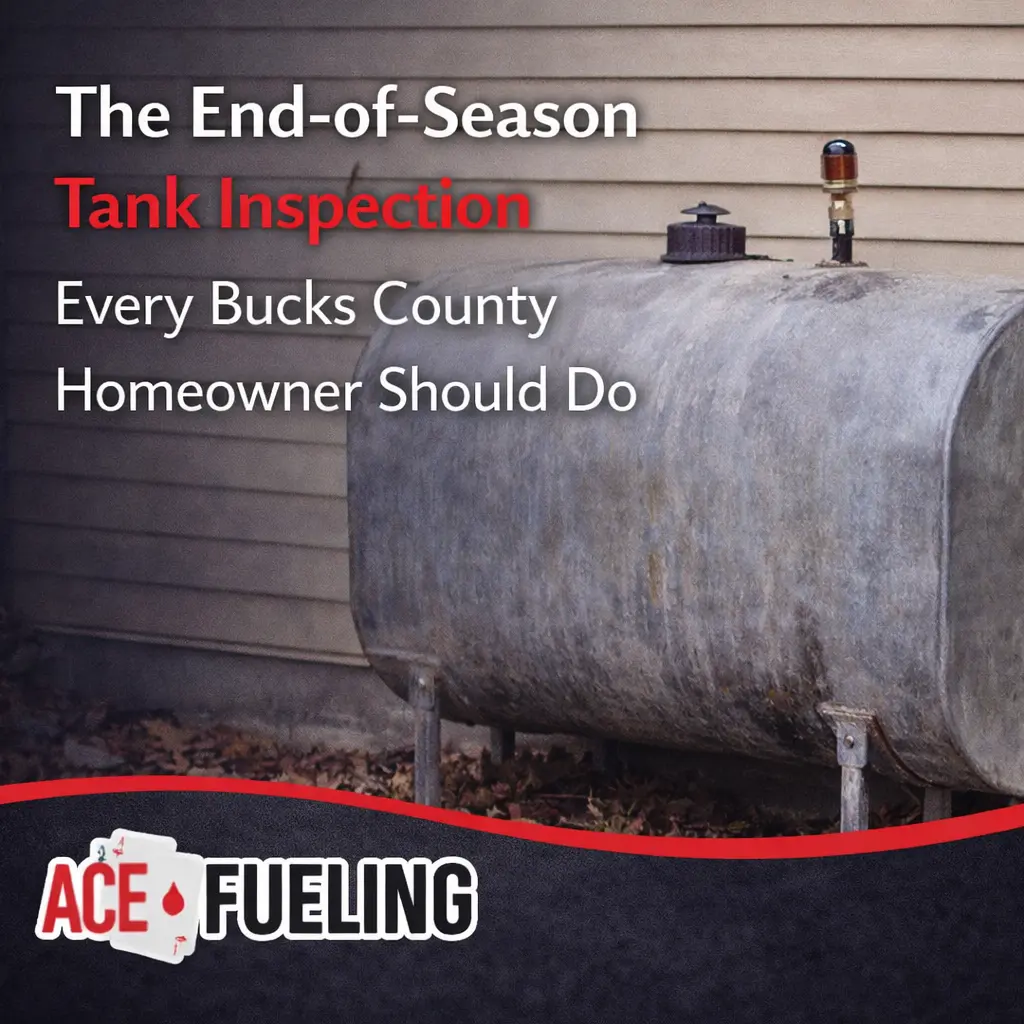
An end-of-season oil tank inspection is the single most overlooked maintenance task among Lower Bucks County homeowners—and skipping it is one of the most expensive mistakes you can make. Ace Fueling, a Bristol-based heating oil delivery company serving over 5,000 customers since 2018, has seen firsthand how a 15-minute spring inspection prevents hundreds or even thousands of dollars in emergency repairs, tank replacements, and environmental cleanup costs. If your furnace just finished carrying you through another Pennsylvania winter and your plan is to flip the thermostat off and forget about your oil tank until October, this guide is for you.
You’re not alone in ignoring your tank once the weather breaks. Most homeowners in Bristol, Levittown, Bensalem, and throughout Bucks County treat their heating system like a seasonal appliance—turn it on in fall, turn it off in spring, and hope for the best. But heating oil tanks work in the background year-round, and a winter’s worth of thermal cycling, condensation, and wear creates problems that worsen silently all summer. This guide walks you through exactly what to check, what the warning signs mean, and when it’s time to call a professional.
What You’ll Learn
- What Is an End-of-Season Oil Tank Inspection?
- The Real Causes Behind Post-Winter Tank Problems
- Your Step-by-Step Spring Tank Inspection Checklist
- What to Do When You Find a Problem
- Why Lower Bucks County Homeowners Choose Ace Fueling
- Frequently Asked Questions
- Next Steps
What Is an End-of-Season Oil Tank Inspection?
An end-of-season oil tank inspection is a visual and functional check of your heating oil tank, fuel lines, fittings, and surrounding area performed after the last heating cycle of the season—typically between late March and mid-April in Lower Bucks County. The goal is to catch problems created or worsened during winter before they have all summer to escalate into emergencies.
Common issues an end-of-season inspection catches include:
- Exterior rust, pitting, or wet spots that signal tank wall thinning
- Oil stains or drips beneath fittings, valves, or the tank itself
- Condensation buildup visible on or around the tank
- Damaged or deteriorated fuel lines and connections
- Gauge malfunction showing inaccurate fuel levels
- Uneven settling or shifting of tank supports and legs
Ignoring these signs doesn’t make them go away. A small weep around a fitting in April becomes a leak that stains your basement floor by August. A patch of surface rust becomes a perforation that requires an emergency tank replacement—and potentially an environmental cleanup that can cost $10,000 or more in Pennsylvania. For homeowners in Morrisville, Langhorne, Fairless Hills, Croydon, and beyond, a simple spring walk-around is the cheapest insurance available.
The Real Causes Behind Post-Winter Tank Problems
In our 7 years delivering heating oil to homes across Lower Bucks County, Montgomery County, and Burlington County, NJ, we’ve seen the same post-winter tank problems repeat every spring. Here’s what’s actually happening inside and around your tank once heating season winds down.
Thermal Cycling and Condensation
Throughout winter, your oil tank experiences constant temperature swings. The furnace draws warm oil, the tank cools overnight, and the cycle repeats dozens of times per week. Each cycle causes the air inside a partially empty tank to expand and contract, pulling in moist outside air through the vent cap. That moisture condenses on the cooler interior walls and drips down into the fuel, settling at the bottom of the tank as free water. By the time spring arrives, tanks in Bucks County homes—especially those in unheated basements, garages, or outdoors—can accumulate a significant layer of water that promotes rust and feeds bacteria that create tank-clogging sludge.
Winter Stress on Fuel Lines and Fittings
Repeated freeze-thaw cycles in Lower Bucks County’s climate put mechanical stress on every connection in your fuel system. Metal fittings expand and contract at different rates than copper lines, rubber gaskets, and the tank itself. Over a full heating season, this micro-movement gradually loosens connections, hardens rubber seals, and creates hairline gaps where slow seepage begins. These leaks are often invisible during heating season when oil flows quickly and consistently, but they become apparent in spring when the system sits idle and drips have time to accumulate on the floor beneath your tank.
Corrosion Accelerated by Low Fuel Levels
Tanks that run low on fuel through late winter expose more interior surface area to the moist air that enters through the vent. The combination of oxygen, water vapor, and bare steel accelerates corrosion from the inside out—where you can’t see it. Based on our deliveries to 5,000+ customers across Bucks County, we’ve found that homeowners who let tanks dip below a quarter full during the last weeks of heating season are significantly more likely to discover tank integrity issues during spring inspections. Homes in Warminster, Southampton, Feasterville-Trevose, and Penndel with outdoor above-ground tanks are particularly vulnerable because outdoor temperature swings are more extreme.
Settling and Structural Shifts
A full 275-gallon oil tank weighs roughly 2,000 pounds. Over years of heating seasons, the legs and cradle supporting the tank can slowly sink into basement floors, shift on outdoor pads, or develop uneven weight distribution. Winter ground freeze-thaw cycles accelerate this settling for outdoor tanks throughout Bristol, Levittown, and surrounding areas. An unevenly settled tank puts stress on fuel line connections and can eventually crack a weld seam—problems that are easy to spot with a visual inspection but costly to discover after a failure.
Your Step-by-Step Spring Tank Inspection Checklist
You don’t need tools or technical expertise for this inspection—just 15 minutes, good lighting, and this checklist. Walk through each item and note anything that looks different from what you’d expect on a clean, dry, well-maintained tank.
- Check the floor and ground beneath the tank. Look for any oil stains, wet spots, or discoloration. Even a small dark spot that wasn’t there last spring could indicate a slow leak from a fitting or the tank bottom. Run your finger through any suspect spot—heating oil has a distinct slippery feel and petroleum smell.
- Inspect the tank exterior for rust and pitting. Walk around the entire tank (or as much as access allows) and examine the surface for bubbling paint, orange or brown discoloration, rough patches, or areas where metal appears thinner. The bottom third of the tank is the most vulnerable area because that’s where interior water and sludge collect and corrode from the inside.
- Examine all fittings, valves, and connections. Look at every point where a pipe, line, or fitting connects to the tank. Check for green or white mineral deposits on copper fittings (signs of slow seepage), oil residue around threaded connections, and any fitting that appears loose or misaligned.
- Check the fuel lines for damage. Trace the fuel line from the tank to the furnace. Look for kinks, cracks, abrasion marks, or sections where the line sags unsupported. Copper lines should be firm and straight; any flex line or rubber section should be pliable, not stiff or cracked.
- Read the tank gauge. Note your current fuel level. If the gauge seems stuck, reads full when you know it shouldn’t, or the needle doesn’t move smoothly, the gauge mechanism may be faulty—a common issue that leads homeowners to run out of oil unexpectedly the following winter.
- Inspect the vent pipe and cap. The vent pipe (usually visible on the exterior wall for indoor tanks, or on top of outdoor tanks) should be clear of debris, insect nests, and ice damage. A blocked vent creates pressure imbalances that affect fuel flow and can cause your gauge to read inaccurately.
- Assess the tank supports and level. Place a level on top of the tank or simply observe whether it appears tilted. Check that legs or cradle are firmly seated and haven’t shifted. For outdoor tanks, inspect the concrete pad for cracking, heaving, or erosion around the base.
- Note your fuel level and consider a spring fill. If your tank is below half, this is the ideal time to order a spring fill-up while prices are at their seasonal low. A full tank prevents summer condensation, protects against interior corrosion, and ensures you’re ready for next heating season without paying peak fall prices.
What to Do When You Find a Problem
Minor Issues You Can Monitor
Some findings from your spring inspection are worth noting and watching rather than immediately acting on:
- Light surface rust on an older tank with no soft spots or pitting—sand lightly and apply rust-inhibiting paint.
- A very small amount of dust or discoloration beneath fittings that doesn’t appear wet or oily—clean the area and recheck in 30 days.
- A slightly stiff gauge needle—tap gently and observe whether it frees up; if not, plan for gauge replacement before fall.
Serious Issues That Need Professional Attention
Contact a qualified heating technician or tank specialist right away if you discover:
- Active dripping or pooling of oil anywhere around the tank, lines, or fittings.
- Soft, spongy, or perforated areas on the tank exterior—this indicates wall thinning from interior corrosion and the tank may be close to failure.
- Strong petroleum odor in the basement or around the tank area without a visible source.
- Significant tank settling, tilting, or leg damage that puts stress on fuel connections.
- Any evidence of oil on the ground outside your home, which may require reporting to the Pennsylvania Department of Environmental Protection.
Keep Your Tank Full with Ace Fueling
Regardless of what your inspection reveals, the single best thing you can do for your oil tank this spring is fill it. A full tank displaces moisture-laden air, slows corrosion, prevents sludge formation, and locks in seasonal pricing that’s typically 20–40 cents per gallon lower than fall rates. Ace Fueling delivers same-day throughout Lower Bucks County, Montgomery County, and Burlington County with no contracts and the lowest prices guaranteed. Call (215) 458-7523 or text Jon directly at (267) 679-2242.
Why Lower Bucks County Homeowners Choose Ace Fueling
Since 2018, Ace Fueling has been the go-to heating oil provider for homeowners across Lower Bucks County, Montgomery County, and Burlington County, NJ. Owner Jon started this company because he saw too many local families getting overcharged, underserved, and locked into contracts that didn’t benefit them.
Here’s what sets Ace Fueling apart:
- Over 5,000 satisfied customers with a 5-star average Google rating.
- Bristol-based operations—Jon knows neighborhoods from Croydon to Yardley to Horsham.
- Price match guarantee ensures you always get the lowest rate available.
- No contracts, ever. COD means you order only when it makes sense for you.
- Same-day delivery 7 days a week—orders before 2 PM typically delivered same day.
- Licensed, insured, and DOT-registered (3148867) with calibrated metering for guaranteed accuracy.
- Direct access to owner Jon—call (215) 458-7523 or text (267) 679-2242. No call centers, no runaround.
- Multiple discounts: Military/Veterans 3¢/gal, Seniors 3¢/gal, Cash 5¢/gal, Referral $25 off for both parties.
Frequently Asked Questions
When should I inspect my oil tank after heating season?
The best time is between late March and mid-April, right after your furnace runs its last regular cycle for the season. In Lower Bucks County, this typically coincides with daytime temperatures consistently staying above 50°F. Inspecting early gives you time to address any issues before summer heat accelerates corrosion.
How long does a home oil tank inspection take?
A thorough visual inspection takes about 15 minutes. You don’t need special tools or technical expertise—just good lighting, the checklist in this guide, and a willingness to look closely at every fitting, valve, and surface of the tank.
What are the signs my oil tank needs to be replaced?
Soft or spongy spots on the tank surface, active leaks or oil pooling beneath the tank, heavy pitting that has eaten through the paint and into bare metal, and a tank older than 20–25 years are all strong indicators. A qualified technician can perform an ultrasonic thickness test to measure wall integrity.
How much does an oil tank replacement cost in Bucks County?
A standard indoor 275-gallon oil tank replacement in Lower Bucks County typically ranges from $1,500 to $3,000 installed, depending on access, disposal of the old tank, and any code requirements. Catching problems early through annual inspections helps you plan and budget rather than facing an emergency.
Should I fill my oil tank in spring even though heating season is over?
Yes. A full tank prevents summer condensation, inhibits interior corrosion and sludge formation, and locks in spring prices that are typically 20–40 cents lower per gallon than fall rates. It’s the most cost-effective maintenance step you can take. Call Ace Fueling at (215) 458-7523 for today’s price.
Can I inspect an underground oil tank myself?
Underground tanks require professional inspection because the tank surface isn’t visible. If your Bucks County home has an underground tank, contact a certified tank testing company for pressure testing or soil sampling. Pennsylvania regulations require reporting any suspected underground tank leaks.
Does Ace Fueling offer tank inspection services?
Ace Fueling specializes in heating oil delivery, not tank inspection or repair. However, Jon is happy to point you toward reputable local technicians if your spring inspection reveals issues. Call (215) 458-7523 or text (267) 679-2242 with any questions.
What happens if my oil tank leaks?
An oil tank leak requires immediate professional attention. Contain the area if possible, avoid ignition sources, and contact a licensed environmental cleanup company. In Pennsylvania, oil spills exceeding 25 gallons or impacting soil or water must be reported to the PA Department of Environmental Protection. Early detection through routine inspection is the best way to prevent significant leaks.
Next Steps: Protect Your Tank and Your Wallet This Spring
Here’s what to take away from this guide:
- A 15-minute visual inspection after heating season catches small problems before they become expensive emergencies.
- Condensation, corrosion, loose fittings, and settling are the four biggest post-winter tank risks for Bucks County homes.
- Filling your tank in spring prevents summer damage and locks in the lowest seasonal prices.
- Ace Fueling delivers same-day with no contracts and the lowest prices guaranteed—the easiest way to protect your system right now.
Ready to fill your tank while spring prices are at their lowest? Get a free, no-obligation quote from Ace Fueling today.
Call: (215) 458-7523
Text: (267) 679-2242
Order Online: ace4oil.com
Jon answers directly—not an automated system, not a call center. Same-day delivery available 7 days a week, 6 AM–8 PM, with 24/7 emergency service. Serving Lower Bucks County, Montgomery County, and Burlington County, NJ.
Your House Always Wins!